 Top Faith Senior Care
Common Problems Faced by Elderly Singaporeans and How Caregivers Help
Discover how caregiver support helps with common problems faced by the elderly in Singapore — from mobility and falls to daily care and companionship.
## Key Takeaways
The problems faced by the elderly in Singapore extend beyond health to include mobility, safety, and emotional well-being.
Assistance with daily activities helps seniors maintain independence while reducing everyday risks.
Home environments in HDB flats can increase fall risk without proper supervision and small home adjustments.
Caregiver support improves both physical safety and emotional stability through consistent routines and companionship.
Engaging structured support allows families to manage care sustainably while ensuring their loved ones remain safe and supported.
## Introduction
By 2030, [1 in 4 Singaporeans will be aged 65 or older](https://www.moh.gov.sg/). Around 1 in 3 seniors falls at least once a year, and falls remain the leading cause of injury-related hospitalisation among the elderly here. For families, these are not abstract statistics. They translate into daily worries about safety, independence, and how to provide care without burning out.
As the population ages, many families in Singapore encounter similar challenges when supporting elderly loved ones at home. These problems faced by the elderly in Singapore often extend beyond health concerns to include mobility, safety, emotional well-being, and daily living routines.
Understanding how caregiver support addresses these common problems helps families move from reactive care to more stable, sustainable solutions.
In Singapore, these struggles often unfold within HDB flats or condominiums, where compact layouts, bathroom step-ups, and lift access directly influence safety and mobility. At the same time, families must balance caregiving responsibilities with work commitments, particularly in dual-income households where adult children are away for extended hours.
## Daily Living Challenges That Affect Elderly Independence
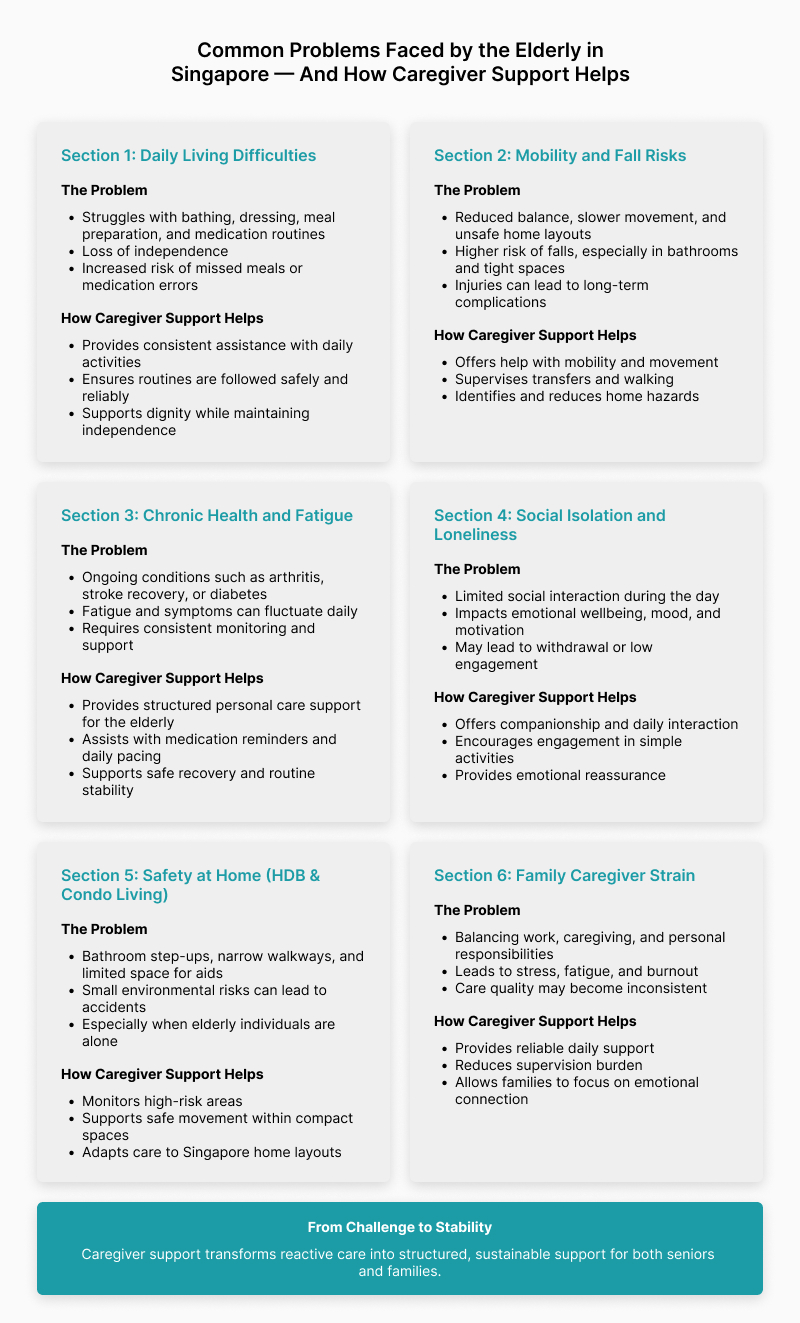
Many elderly individuals face difficulties with everyday tasks such as bathing, dressing, preparing meals, or moving safely around the home. These challenges can gradually reduce independence and increase reliance on family members. Without consistent support, small difficulties may compound into safety risks or emotional strain.
This is where dedicated assistance with daily activities becomes essential. Caregivers help maintain routines while ensuring essential needs are met reliably, from hygiene to meal preparation and medication reminders. With structured support, elderly individuals can continue living at home with greater dignity and consistency.
Some families initially rely on an existing Migrant Domestic Worker (MDW) to assist with daily tasks. While this may work for lighter support, increasing care complexity often requires clearer role definitions or more specialised personal care support for the elderly.
Families exploring more structured options may consider engaging professional [elderly caretaker services](/services) to ensure care is delivered with a dedicated focus on elder-specific needs.
## Safety and Mobility Concerns at Home
Falls and accidents remain one of the most pressing problems faced by the elderly in Singapore. Reduced balance, slower movement, and unfamiliar layouts can increase risk, particularly in bathrooms or during night-time movement.
Caregivers provide critical help with mobility and movement, assisting with transfers, walking support, and supervision in high-risk areas. This reduces the likelihood of avoidable incidents while helping seniors move with greater confidence.
In many HDB homes, environmental factors such as narrow corridors, raised bathroom thresholds, and limited space for mobility aids can increase fall risk. Even minor balance issues can become significant safety concerns in compact layouts, making constant supervision and small home adjustments especially important.
## Emotional Wellbeing and Social Isolation
Beyond physical challenges, emotional well-being is a key concern. Loneliness and reduced social interaction are common among the elderly, especially when they spend long hours alone while family members are at work.
Caregiver support introduces regular companionship and interaction, helping seniors feel reassured and connected. Daily conversations, shared routines, and simple engagement can significantly improve mood and motivation.
In some cases, families may also explore alternative living arrangements such as [elderly co-living](/senior-co-living) services, where social interaction is built into the living environment.
## The Impact on Families Providing Care
Caregiving responsibilities often fall on family members who are also managing careers and personal commitments. Over time, this can lead to fatigue, stress, or burnout, especially when supervision is required consistently throughout the day.
Caregiver support helps redistribute these responsibilities, allowing families to focus on emotional connection rather than constant task management. It creates a more balanced caregiving structure that is sustainable over time.
For households engaging an MDW, working with a [maid agency for elderly care](/maids-for-elderly-care) requires understanding Ministry of Manpower (MOM) regulations, including levy obligations and mandated rest days. Families must plan for alternative care arrangements during these periods to ensure continuity.
In the early stages, some families are able to manage independently. However, as care needs increase or become more complex, relying solely on family support may become unsustainable without compromising the senior's safety or well-being.
## Addressing Challenges With Structured Caregiver Support
Understanding the full scope of the problems faced by the elderly in Singapore allows families to seek support that is both practical and empathetic. Effective caregiving goes beyond completing tasks. It requires consistency, awareness, and the ability to respond calmly to changing needs.
At Top Faith Senior Care, [caregivers](/caregivers) are carefully screened and undergo structured in-house training to ensure they are prepared for real-life caregiving situations. This includes managing mobility concerns, supporting daily routines, and providing reassurance in unfamiliar or stressful situations.
Care recommendations are also tailored to Singapore's living environment. Factors such as HDB layouts, household work schedules, and existing MDW arrangements are taken into account to provide care solutions that are realistic and sustainable.
If you are exploring caregiving options, our team can help you assess your situation and recommend a structured care plan that supports both your loved one's wellbeing and your family's capacity.
## Government Support Schemes for Elderly Care in Singapore
Beyond arranging daily care, it is also important for families to understand the financial and community support schemes available in Singapore. Many elderly Singaporeans may qualify for government assistance that helps reduce caregiving and healthcare costs.
The [Agency for Integrated Care (AIC)](https://www.aic.sg/) supports families by helping them navigate Singapore's eldercare system, including referrals to home care services, caregiver support programmes, community resources, and subsidy applications. Families can also approach AIC for care assessments and recommendations based on the elderly person's care needs.
Several national schemes may also help ease the financial burden of caregiving and long-term support:
- **CHAS (Community Health Assist Scheme)** helps eligible seniors access subsidised outpatient care and chronic disease management at participating clinics.
- **The Home Caregiving Grant** provides eligible families with a monthly payout of up to $400 for seniors with permanent moderate disability.
- **The Pioneer Generation Package and Merdeka Generation Package** offer additional healthcare subsidies and support for older Singaporeans.
- **CareShield Life** provides long-term financial support for individuals who develop severe disabilities.
- **The Seniors' Mobility and Enabling Fund** helps subsidise mobility aids, assistive devices, and home healthcare equipment that support safer ageing at home.
Understanding these schemes allows families to make more informed caregiving decisions while ensuring elderly loved ones receive the support they need both medically and financially.
## Frequently Asked Questions
### What common problems do elderly individuals in Singapore face at home?
The most common problems faced by elderly individuals in Singapore at home include mobility difficulties, fall risks in HDB bathrooms, medication management, social isolation, and fatigue from chronic conditions.
### How does caregiver support reduce fall risk in Singapore homes?
Caregivers assist with safe transfers, supervise movement in high-risk areas such as bathrooms, and help pace activities to prevent fatigue. Their presence allows early identification of hazards and reduces the likelihood of accidents.
### Can an MDW provide sufficient support for elderly care?
An MDW may assist with light daily tasks and supervision. However, more complex care needs often require specialised training or a dedicated caregiver focused on eldercare. Families must also account for rest days and regulatory requirements.
### How does caregiver support help with emotional well-being?
Caregivers provide companionship, routine interaction, and reassurance. This helps reduce loneliness and supports emotional stability, particularly for seniors who spend much of their day at home.
### When should families seek additional caregiving support in Singapore?
Families should consider structured support when safety concerns increase, supervision becomes necessary throughout the day, or caregiving responsibilities begin to strain household members. Guidance from organisations like the Agency for Integrated Care can also help identify suitable care pathways.
### How much does an elderly caregiver cost in Singapore?
Elderly caregiver costs in Singapore vary based on care needs, experience, and whether support is part-time or live-in. Families should also factor in insurance, levies, daily expenses, and available subsidies such as the Home Caregiving Grant. Our [cost to hire a caregiver](/cost-to-hire-caregiver-singapore) guide breaks down what to expect.
### What is the difference between a maid agency and a caregiver agency for elderly care?
A maid agency mainly focuses on domestic help, while a caregiver agency specialises in elderly support, caregiver matching, and ongoing care coordination for seniors requiring assistance with mobility, supervision, hygiene, or daily activities.
## Moving Towards Sustainable Elderly Care at Home
Supporting an ageing loved one requires more than occasional help. It involves consistent care, thoughtful planning, and the ability to adapt as needs change. By recognising the problems faced by the elderly in Singapore early, families can take a more proactive approach to care.
With the right caregiver support in place, seniors can maintain their independence while staying safe and emotionally supported. At the same time, families gain the reassurance and stability needed to sustain care over the long term.
At Top Faith Senior Care, every placement is guided by clinical insight, having been founded by two experienced nurses who understand both the medical and practical realities of caregiving. Caregivers are also matched using an AI-driven system that considers over 25 factors, ensuring alignment with each family's unique needs, home environment, and care requirements.
[Contact us](/contact) if you are navigating caregiving decisions and would like to explore solutions tailored to your home, your schedule, and your loved one's needs.
← Back to all articles